


For a long time, multigenerational living had a reputation problem. It was the option families turned to when something had gone wrong — a job loss, a divorce, a health crisis. Moving back in with your parents, or having your parents move in with you, meant something hadn’t worked out.
That story has changed pretty significantly.
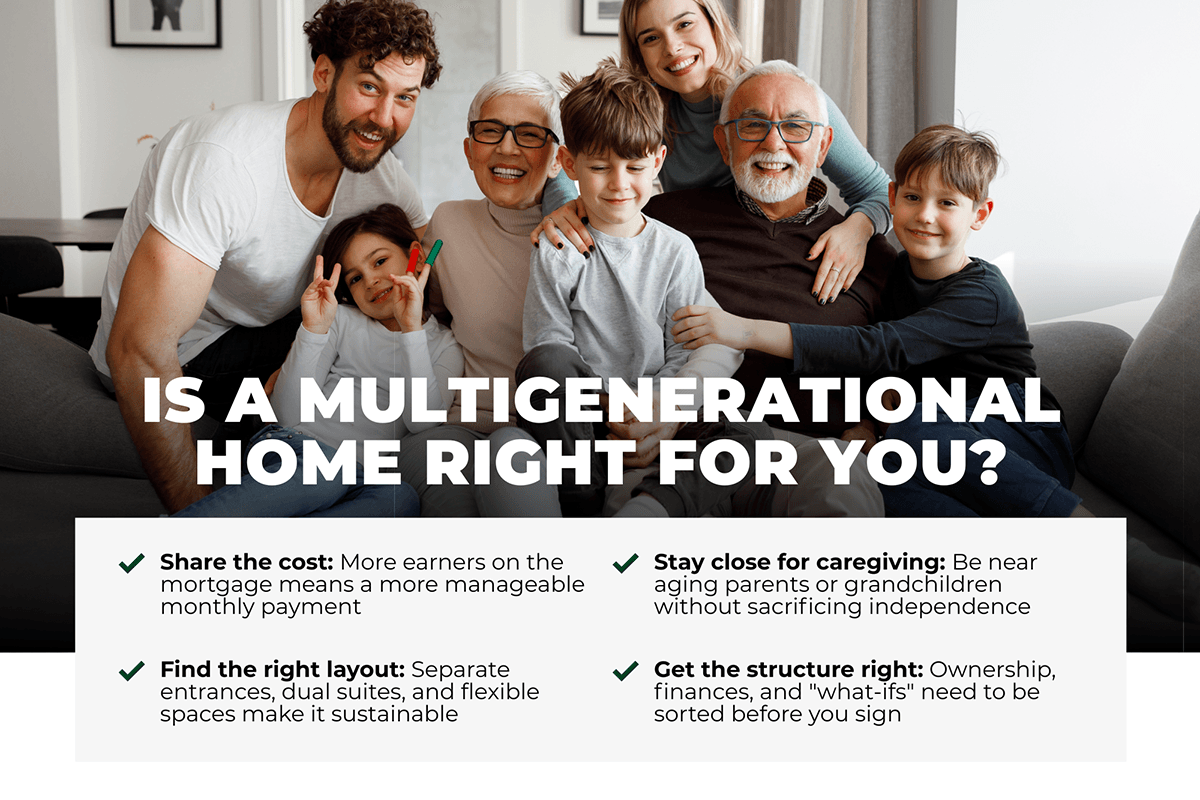
Today, families are choosing this arrangement on purpose — not as a fallback, but as a deliberate decision to share costs, stay connected, and build something that actually works for how their lives are structured right now.
According to NAR, 14% of buyers recently purchased a multigenerational home, and the year before that hit 17%. [1] These aren’t people making the best of a bad situation. They’re rethinking what “home” needs to do.
If this is something you’re considering — or something a family member has brought up — here’s what’s worth knowing before you start the search.
TL;DR
Multigenerational home buying is on the rise, driven by caregiving needs, rising costs, and remote work flexibility.
Success comes down to three things: finding a property with genuine privacy and long-term adaptability, understanding the financial and legal structure before closing, and having honest family conversations about shared expectations — including the what-ifs.
When all three are in place, it can work very well.
Why More Families Are Going This Route
The honest answer is: it’s rarely just one thing.
For most families, cost is somewhere in the mix. Buying together means more income earners on the loan, more people splitting the mortgage, and a monthly payment that’s easier to justify. But if you talk to families who’ve actually done it, the financial piece rarely tells the whole story.
Caregiving comes up constantly. Nearly half of multigenerational buyers in NAR’s research cited caring for or wanting to be near aging parents as a primary reason for the purchase. [1][4] For older millennials in particular, aging-parent health and caretaking responsibilities were a major driver. That’s not a trend that’s going away — there are now more than 70 million Americans age 65 or older, and the question of how families want to handle that isn’t one most people want to outsource entirely. [2]
Remote work has also quietly changed the math. When you’re not tethered to an office, living near family becomes less of a sacrifice. You can be close without it costing you professionally, which is a relatively new dynamic. [3]
And then there’s the harder-to-quantify stuff — the daily support, the shared routines, the sense that you’re not navigating things alone. For families with young kids, having grandparents nearby can be transformative. For families with aging parents, so can having adult children close.
The point is: if you find yourself drawn to this idea, you’re in good company, and your reasons are probably more layered than just the numbers.
What to Actually Look for in a Property
This is where a lot of families get tripped up. They find a house they love, start imagining how it could work, and convince themselves the layout is more flexible than it really is. Then six months into living together, they realize what they actually needed was a separate entrance, not just a second bathroom.
The properties that work best for multigenerational living tend to share a few things in common.
They take privacy seriously. Not just in theory, but in the layout. Dual primary suites, separate entrances, a finished basement with its own sitting area, or a detached guest house — these aren’t luxury features, they’re what make the arrangement actually sustainable. If each household can’t fully decompress, host their own guests, and keep their own rhythm, the togetherness part gets old fast. Home design professionals increasingly flag this as the most important feature to get right, and it’s easy to see why. [5][6]
They’re built — or can be converted — for flexibility. ADUs (accessory dwelling units) have become a serious part of this conversation as more cities loosen zoning restrictions. A detached ADU gives you the ultimate setup: close enough to matter, separate enough to breathe. If an ADU isn’t already in place, it’s worth asking whether the lot and local zoning would allow for one down the road. [5][6]
They work for the long game. Think about where everyone in the arrangement will be in ten or fifteen years. First-floor suites, wider hallways, zero-step entries, and rooms that can adapt as needs change aren’t just nice to have — they’re what make a multigenerational home function well over time rather than just right now. [6][7]
The short version: the best multigenerational properties support both togetherness and independence. If a home checks one but not the other, keep looking.
The Conversations Most Families Skip
Here’s the part that tends to get glossed over, because the emotional pull of the idea is strong and the practical details feel like they can wait. They can’t. ⬅️
Start with the financial structure early. If multiple people will be on the loan, everyone needs to understand what that actually means. Co-borrowers can combine income and assets to qualify for more — but they also share legal responsibility for the debt and share in whatever equity the home builds. That’s meaningfully different from being a co-signer, who carries the liability but doesn’t own a piece of the property. Knowing which structure makes sense for your family is a conversation to have with a lender before you fall in love with a house. [8]
Define ownership clearly. There are several ways to structure who owns what — joint tenancy, tenancy in common, shared-equity arrangements — and each one affects what happens if someone wants to sell, refinance, or passes away. Equal contributions don’t automatically mean equal ownership makes sense, and unequal contributions don’t mean anyone is getting a bad deal. But these things need to be spelled out explicitly, not assumed. [8]
Get it in writing. A verbal agreement between family members feels fine when everyone is on the same page. It gets complicated when circumstances change — and circumstances always change eventually. A written agreement that covers shared expenses, maintenance responsibilities, common areas, and how exits would be handled gives everyone protection and, honestly, usually makes the conversations easier because you’ve already had them. [9]
Talk through the “what-ifs” before closing. Job relocations, caregiving shifts, a marriage, someone wanting to sell — these aren’t worst-case scenarios, they’re just life. The way a home is titled can affect everything from Medicaid eligibility to how inheritance plays out. It’s worth a conversation with an estate planning attorney or real estate attorney before you close, not after. [9]
This stuff isn’t fun to work through. But families who do it upfront tend to have far smoother experiences than those who assume it’ll all work itself out.
Is This Actually the Right Move?
That depends on a few honest questions.
Is everyone genuinely choosing this, or is someone going along with it? The families who thrive in multigenerational arrangements almost always went in with shared intent — everyone wanted it, everyone understood what they were agreeing to. That’s different from one party tolerating it because the math made sense or because it felt like the easier thing to say yes to.
Are the financial expectations clear and actually fair? Not just the down payment, but ongoing contributions, equity stakes, and what happens if someone needs to exit. These things are much easier to define before the purchase than to renegotiate afterward.
Does everyone have a realistic picture of what shared space feels like day-to-day, long-term? Not on a good weekend when everyone’s happy to be together — but on a random Tuesday when someone’s had a bad day, the kids are loud, and you just want your house to yourself for an hour.
If the answers to those questions are honest and mostly positive, multigenerational living can be genuinely great. The data backs that up. So do plenty of real families who’ve made it work.
The Bottom Line
Multigenerational living has moved from fallback plan to deliberate strategy for a growing number of families — and it’s easy to understand why. The financial upside is real, the caregiving benefits are real, and when it’s set up well, the emotional rewards are too.
What makes it work is going in with eyes open: the right property, the right legal structure, and honest conversations before anyone signs anything.
If this is something your family is exploring — or if it’s on the horizon and you’re not sure where to start — that’s exactly the kind of conversation a good agent can help you think through. Getting the strategy right early makes everything that follows a lot smoother.
Reach out anytime — even if you’re just starting to think it through.
Sources
- National Association of REALTORS® — Making Extra Room at the Table: Multi-Generational Homes in the United States
https://www.nar.realtor/blogs/economists-outlook/making-extra-room-at-the-table-multi-generational-homes-in-the-united-states - National Association of REALTORS® — The “Silver Tsunami” in Real Estate Is Here: Are You Ready?
https://www.nar.realtor/magazine/real-estate-news/the-silver-tsunami-in-real-estate-is-here-are-you-ready - U.S. Census Bureau — New U.S. Census Bureau Data Show Detailed Characteristics of Home-Based Workers
https://www.census.gov/library/stories/2025/01/work-from-home-inequalities.html - National Association of REALTORS® — One Big Happy Household: How Families and the Data Are Shaping Multigenerational Living
https://www.nar.realtor/blogs/economists-outlook/one-big-happy-household-how-families-and-the-data-are-shaping-multigenerational-living - Better Homes & Gardens — Multigenerational Living Will Define the Future of Home Design, According to Thumbtack and Redfin
https://www.bhg.com/thumbtack-redfin-home-design-report-2026-11869197 - The House Plan Company — How 2025 Is Redefining Multigenerational Home Design
https://www.thehouseplancompany.com/blog/how-2025-is-redefining-multigenerational-home-design/ - National Association of REALTORS® — All Under One Roof: Trends in Multigenerational Living
https://www.nar.realtor/magazine/real-estate-news/home-and-design/all-under-one-roof-trends-in-multigenerational-living - The Mortgage Reports — How to Buy a House With Your Parents
https://themortgagereports.com/77007/buying-a-home-with-parents-or-child - Elder Law Answers — Home Ownership When Parents and Adult Children Live Together
https://www.elderlawanswers.com/what-are-the-house-ownership-options-when-parents-and-adult-children-live-together-14484



Leave a Reply